Unlocking the Power of Queries: A Guide for Businesses

Updated: Apr 24
Understanding the Foundation: What a Real Query Looks Like
A proper data query has three components:
Entity + Context + Signal
Entity → what you are looking for
Context → where it exists
Signal → proof that the data exists
For example:
"restaurant owner" "Mumbai" "email"
This is no longer browsing.
This is filtering.
The First Upgrade: From Queries to Query Sets
One query gives you results.
A query set gives you coverage.
Instead of running:
"restaurant owner Mumbai email"
You should run:
"restaurant owner" "Mumbai" "email"
"restaurant group" "Mumbai" "contact"
"hospitality management" "Mumbai" "team"
intitle:"restaurant group" "Mumbai"
Each query hits a different surface:
directories
team pages
listings
structured pages
Now you’re not searching.
You’re mapping a data landscape.
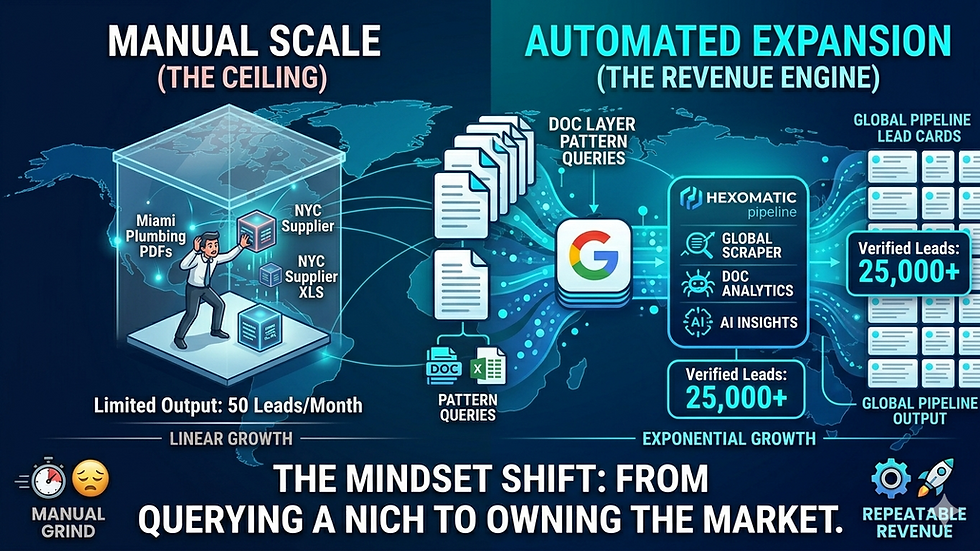
The Hidden Layer: Documents Are Better Than Websites
Most people scrape websites.
That’s a mistake.
Websites are optimized for SEO.
Documents are optimized for internal use.
Try these queries:
filetype:pdf "vendor list" "India"
filetype:xls "supplier" "Pune"
filetype:csv "contact" "department"
What you get:
internal spreadsheets
procurement lists
structured contact data
No fluff. No design. Just information.
The Real Shift: From Extraction to Systems
Basic approach:
Search → Click → Copy → Paste
Slightly better:
Search → Extract → Export
Advanced approach:
Search → Extract → Enrich → Classify → Filter → Output
This is where systems are built.
Turning Queries into Repeatable Systems
Let’s take a business problem:
👉 “Why is my website not getting traffic?”
Instead of answering manually, you design a system.
Step 1: Define Query Inputs
INPUT: website_url
Step 2: Build Query Layers
Q1: Crawl(website_url)
Q2: Extract(seo_signals from Q1)
Q3: Extract(content_topics from Q1)
Q4: Fetch_SERP_competitors(Q3)
Q5: Compare(Q2, Q4)
Step 3: Add Classification Layer
Q6: Identify_issues(Q5)
Q7: Classify_impact(Q6)
Step 4: Add Decision Layer
Q8: Prioritize(Q7)
Final Output
Score
Issues
Impact
Fix
Priority
Now this is not a report.
This is a repeatable system.
Query Composition: The Real Advantage
Single queries are useful.
But real intelligence comes from composed queries.
Example:
Q1 → Keywords
Q2 → SERP Data
Q3 → Competitors
Q4 → Content Gaps
Q5 → Opportunity Score
Each query feeds the next.
This creates:
👉 structured insight
👉 not scattered data
Applying This to Modern Visibility (SEO + GEO + AEO)
Search is no longer limited to Google.
You now have:
SEO → rankings
GEO → AI discovery
AEO → answer visibility
So your system evolves:
Visibility Score = SEO + GEO + AEO signals
This is no longer optimization.
This is multi-layer visibility intelligence.
Why Most Businesses Stay Stuck
Because they:
run isolated queries
collect raw data
stop at extraction
They never:
build query sets
layer queries
classify outputs
The Real Outcome: Decision Systems
When done right:
You don’t get:
reports
dashboards
spreadsheets
You get:
👉 decisions
What to fix
Where to invest
What will move the needle
Final Thought
The difference between beginners and operators is simple:
Beginners search
Operators design queries
Advanced users build systems
Once your queries become repeatable…
Your growth does too.
Why You Need a Digital Marketing Consultant
In today's competitive landscape, having a strong online presence is crucial.
We help businesses like yours. Do you need online presence? Want sales growth?
We offer digital advertising and lead generation campaigns.
It's a one-stop solution. We assure results, 100%.
We are here 24/7. Get a free consultation, a campaign plan, even a landing page, just for you.
We make online advertising easy and effective. We focus on your success.
If you want to stay two steps ahead in this industry, you need a solid analysis and action plan.
Leverage AI and start using https://nsdmai.com.
Author Note: It's a bit different, but it's 100% niche if you want to see yourself on top, not only from SEO but also from Generative Engine Optimization (GEO) and Answer Engine Optimization (AEO) angles.
Comments