Did Google Kill FAQ Schema?

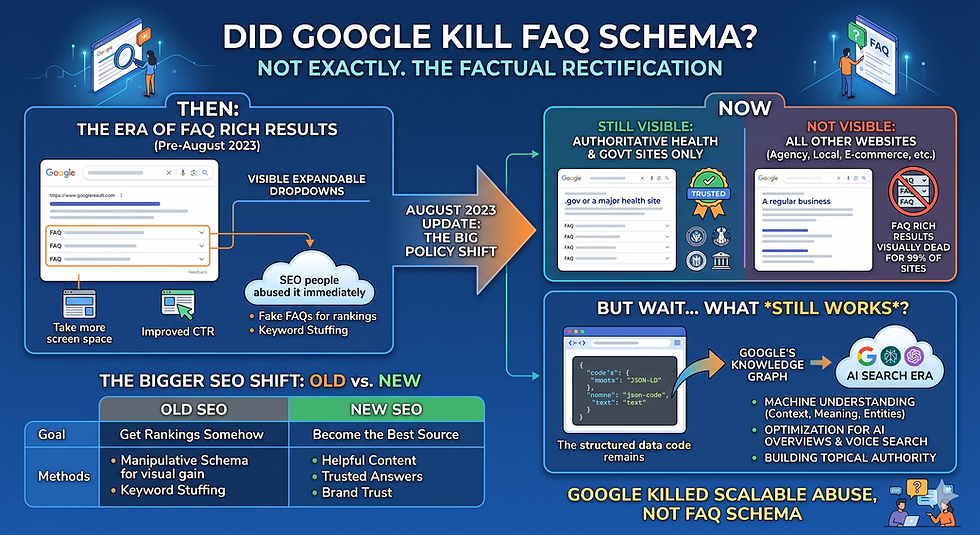
Not Exactly. Here’s What Actually Happened.
Over the last few months, the SEO industry exploded with headlines like:
“FAQ Schema is dead”
“Google killed FAQ rich results”
“Schema markup no longer works”
And naturally, half the internet panicked.The other half started selling “new secret SEO methods.” Humanity remains committed to turning every Google update into a doomsday cult 😌
But the reality is much more interesting.
Google did NOT completely kill FAQ schema.
What Google actually did was reduce the visibility of low-quality, overused FAQ rich results.
That’s a massive difference.
First, What Is FAQ Schema?
FAQ Schema is structured data added to a webpage that helps Google understand:
Questions on the page
Answers related to those questions
When Google trusts the content, it may show those FAQs directly in search results as expandable dropdowns.
Example:
Before:
Search Result:“How to Learn SEO”
⬇
Google shows:
What is SEO?
How long does SEO take?
Is SEO hard to learn?
This helped websites:
Take more screen space
Improve CTR
Increase visibility
Naturally...
SEO people abused it immediately.
What Went Wrong?
At first, FAQ schema was genuinely useful.
But eventually websites started doing things like:
❌ Adding fake FAQs just for rankings❌ Stuffing keywords into questions❌ Using auto-generated FAQ blocks❌ Adding irrelevant FAQs to every page❌ Copy-pasting the same FAQ structure across hundreds of pages
Example of bad SEO behavior:
A plumber website adding:
“What is the best plumbing service in Mumbai?”
“Why choose affordable plumbing near me?”
“Can cheap plumbing save money?”
Nobody talks like this in real life.
This was not helping users.It was helping rankings.
So Google noticed a pattern:
More schema ≠ better experience.

Google’s Real Problem
Google’s goal is simple:
Give users the best experience possible.
But search results started becoming cluttered with:
Spammy FAQs
Repetitive answers
Low-quality expandable sections
Fake “helpful” content
Imagine searching something and seeing:
10 websites
All with identical FAQ dropdowns
All repeating generic answers
That creates search fatigue.
Google doesn’t want search results to look like a copy-paste marketplace run by anxious marketers and plugins 😌
So Google reduced FAQ rich result visibility for most sites.
Important:
FAQ Schema Still Works
This is the part many people misunderstand.
FAQ schema still works in certain cases.
Especially when:✅ The content is high quality✅ The FAQs are genuinely useful✅ The page has authority✅ The questions support user intent✅ The schema improves understanding
Google didn’t remove FAQ schema from existence.
Google reduced the visibility of manipulative implementations.
The Bigger SEO Shift
This update reveals something much bigger happening in SEO.
Old SEO focused heavily on:
Tricks
Loopholes
Technical exploitation
SERP manipulation
Modern SEO is moving toward:
Trust
Relevance
Authority
User satisfaction
AI understanding
Entity recognition
This is a huge shift.
OLD SEO vs NEW SEO
OLD SEO
Goal:“Get rankings somehow.”
Methods:
Keyword stuffing
Excessive schema
Backlink manipulation
Thin content
Mass-generated pages
Focus:Gaming the algorithm.
NEW SEO
Goal:Become the best source.
Methods:
Helpful content
Topical authority
Brand trust
Real expertise
Strong user experience
AI-search readiness
Focus:Helping users better than competitors.
The AI Search Era Changed Everything
Google is no longer just a search engine.
Now it competes with:
ChatGPT
Gemini
Perplexity
Claude
AI assistants
Voice search systems
This changes SEO completely.
AI systems don’t just analyze keywords anymore.
They analyze:
Meaning
Context
Trustworthiness
Entities
Relationships between topics
That means low-quality FAQ spam becomes less valuable.
Because AI can understand when content is:
Generic
Repetitive
Manipulative
Thin
Unhelpful
Simple Analogy
FAQ Schema is like subtitles in a movie.
Good subtitles improve understanding.
Bad subtitles don’t make a bad movie good.
Schema helps structure content.It cannot rescue weak content anymore.
That’s the key insight.

Real-World Example
BAD EXAMPLE ❌
Page:“Best Digital Marketing Agency”
FAQs:
What is digital marketing agency?
Why digital marketing agency important?
Which digital marketing agency best?
Affordable digital marketing agency near me?
Clearly written for search engines.
Low value.
GOOD EXAMPLE ✅
Page:“Google Ads Services for Real Estate”
FAQs:
How much should a real estate company spend on Google Ads?
Which campaigns generate property leads faster?
How long before lead quality improves?
What targeting works best for luxury projects?
These are real questions from real buyers.
That creates value.
So Should You Still Use FAQ Schema?
Yes.
But intelligently.
Use FAQ schema when:✅ It genuinely improves user understanding✅ Questions are useful✅ Answers are specific✅ FAQs support the page topic naturally
Do NOT use it:❌ Just to occupy more SERP space❌ To inject keywords❌ On every page automatically❌ As a ranking shortcut
The Real Lesson Here
Google updates usually follow a pattern:
Google introduces a feature
SEO industry overuses it
Spam increases
User experience drops
Google reduces abuse potential
Same thing happened with:
Meta keywords
Exact match domains
PBNs
Thin affiliate sites
Mass guest posting
AI spam content
FAQ schema is simply another chapter in that cycle.
Final Takeaway
Google did not kill FAQ schema.
Google killed scalable abuse.
And honestly?That’s where SEO is heading overall.
The future belongs to brands that:
Build trust
Create real expertise
Understand user intent
Structure content properly
Become reliable sources across search and AI systems
Modern SEO is no longer:“Who manipulated the algorithm best?”
It’s:“Who became the most trusted answer?” 🚀 Find the Newsletter here.
Comments